
By Estelle | HerWorkshop.co.uk
I’ve been thinking about what I’d put in a new homeowner’s toolkit for years — ever since I bought my house and had to build mine from almost nothing. After five years of tackling projects from shelves to a full bathroom renovation, I have a very clear sense of which tools you’ll use all the time and which ones just take up space.
This list is practical, honest, and built from experience. No 200-piece sets where 150 pieces are hex keys you’ll never touch. Just the tools that earn their place every single time.
The Non-Negotiables — Tools Every Home Needs
1. Cordless Combi Drill (with Hammer Function)
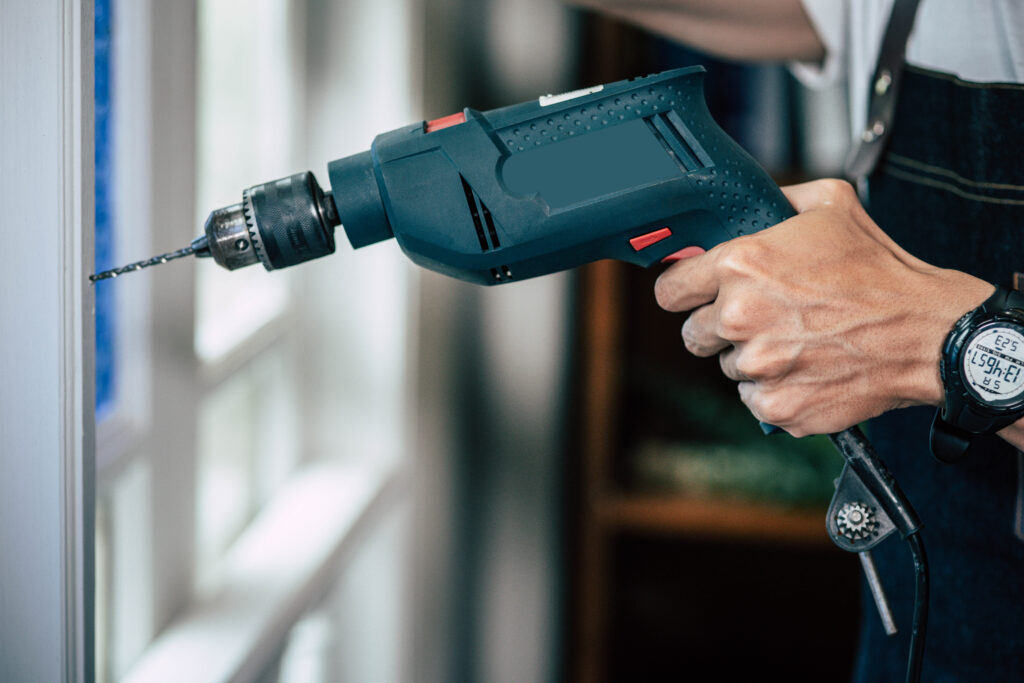
The single most important tool you can own. It drills, drives screws, and — with the hammer function — tackles masonry. UK homes have brick internal walls, and a standard drill won’t cut it. You need hammer mode.
Invest in a brushless model from a reputable brand (DeWalt, Makita, Bosch Professional or Ryobi). The brand choice matters because it locks you into a battery ecosystem — all your future cordless tools will share the same battery.
👉 Check price on Amazon | 👉 Check price at Screwfix
2. Hammer
A solid claw hammer for nails, picture hooks and general persuasion. Look for one with a comfortable grip and a weight of around 450–500g — heavy enough to drive nails properly, light enough not to tire your arm.
👉 Check price on Amazon | 👉 Check price at Screwfix
3. Tape Measure
5 metres minimum. Use it constantly — measuring up for shelves, furniture, flooring, curtain poles. Buy a decent one with a stiff blade that locks reliably. Cheap tape measures have flimsy blades that collapse on longer measurements.
👉 Check price on Amazon | 👉 Check price at Screwfix
4. Spirit Level
You cannot hang anything straight without one. A 600mm level handles most jobs — long enough for shelves and pictures, compact enough to fit in a tool bag. A digital level is useful but not essential.
👉 Check price on Amazon | 👉 Check price at Screwfix
5. Screwdriver Set
Both Phillips (cross-head) and flathead in multiple sizes. A good set will include a ratchet mechanism for faster driving in tight spaces. Cheap screwdrivers slip on screws and damage heads — it’s worth spending £15–£25 on a quality set.
👉 Check price on Amazon | 👉 Check price at Screwfix
6. Pliers
Needle-nose and combination pliers. You’ll use these for gripping, bending wire, tightening fittings and those jobs where your fingers just aren’t enough.
👉 Check price on Amazon | 👉 Check price at Screwfix
7. Adjustable Spanner
For plumbing jobs, tightening nuts and bolts, and any job where you need to grip a hex fitting. One adjustable spanner covers a much wider range than a fixed spanner set.
8. Stanley Knife / Utility Knife
One of the most-used tools in any home. Cutting underlay, scoring plasterboard, opening boxes, trimming carpet. Buy one that takes standard replaceable blades and keep a few spares.
👉 Check price on Amazon | 👉 Check price at Screwfix
9. Allen Key / Hex Key Set
Essential for flat pack furniture assembly. A fold-out set covers all common sizes and takes up almost no space. You’ll use these far more than you expect.
10. Torch or Headlamp
For loft spaces, under-sink plumbing, and dark corners. A headlamp is more practical than a torch for DIY — it keeps both hands free.
The Power Tools Worth Adding Early
11. Jigsaw
Once you’re comfortable with your drill, a jigsaw is the next most versatile power tool. Curves, straight cuts, cutting around obstacles — it handles jobs a circular saw can’t. A beginner-friendly corded option like the Bosch PST 700 E starts around £55.
👉 Check price on Amazon | 👉 Check price at Screwfix
12. Sander (Random Orbital)
For furniture, floors, and anywhere you need a smooth finish. A random orbital sander avoids swirl marks and is easy to use. Essential for any upcycling or woodworking project.
👉 Best random orbital sanders on Amazon — [AFFILIATE LINK PLACEHOLDER]
13. Stud Finder
Before you drill into any wall, you need to know what’s behind it. Stud finders locate wooden studs, metal pipes and electrical cables. A magnetic model works well for finding metal fixings in plasterboard walls. A deeper-scanning electronic model finds cables and pipes too.
👉 Check price on Amazon | 👉 Check price at Screwfix
The Accessories That Make the Difference
- Drill bit set — get a mixed set including masonry, wood and metal bits in a range of sizes.
- Screwdriver bit set — dozens of bits for your drill driver, including Torx, Pozidriv and Phillips.
- Wall plugs and screws — a mixed assortment for different wall types and loads.
- PVA glue and wood glue — for repairs and woodworking projects.
- Sealant gun and silicone sealant — for bathrooms, kitchens and window frames.
- Sandpaper mixed pack — 80, 120 and 240 grit covers most jobs.
- Knee pads — laughed at until you spend a day on hard floors.
- Safety glasses and ear defenders — non-negotiable when using power tools.
What to Spend — A Realistic Budget Guide
| Priority | Tools | Approx Budget |
|---|---|---|
| Essential basics | Hammer, tape, level, screwdrivers, pliers, spanner, Stanley knife, Allen keys | ~£40–£60 |
| First power tool | Cordless combi drill + battery + charger | ~£80–£150 |
| Second power tool | Jigsaw | ~£50–£80 |
| Useful additions | Sander, stud finder, spirit level upgrade | ~£50–£100 |
| Total to be well equipped | ~£220–£390 |
💬 Estelle’s note: When I bought my house, I started by buying a decent drill and a basic hand tool set, then added tools as projects demanded them. A jigsaw when I started the flooring. A sander when I began upcycling furniture. A multi-tool when I renovated the bathroom. That’s the sensible approach — buy what you need, when you need it, and buy it properly.
Frequently Asked Questions
What’s the most important tool to buy first?
A cordless combi drill with hammer function — without question. It’s the most versatile tool you’ll own, and choosing the right brand locks you into a battery ecosystem that all your future tools will share.
Should I buy a kit or individual tools?
A pre-made hand tool kit is a good starting point for the basics — they’re cost-effective and save you making lots of individual decisions. For power tools, always buy individually so you can choose the right brand and model for your needs.
What brand should I choose for power tools?
DeWalt, Makita and Bosch Professional are the top three for quality. Ryobi is excellent for lighter-duty DIY at a lower price point. The key is to pick one and stick with it so all your batteries are compatible.
Do I need a toolbox or tool bag?
Either works — it depends on whether you move tools between locations. A rigid toolbox is better for home storage and workshop use. A tool bag is more practical if you work in multiple rooms or take tools to other properties.
Final Thoughts
You don’t need 200 tools to be well-equipped. You need the right 15 — chosen carefully, quality where it counts, and supplemented as projects demand more.
Start with the non-negotiables, invest in a good drill, and build from there. Your toolkit will grow naturally with your skills and ambitions. That’s how the best workshops are built — one good tool at a time. 🔧
This post contains affiliate links. If you buy through my links, I may earn a small commission at no extra cost to you. I only ever recommend tools I genuinely believe in.
Have questions? Drop them in the comments below — I’m happy to help! 🔧